
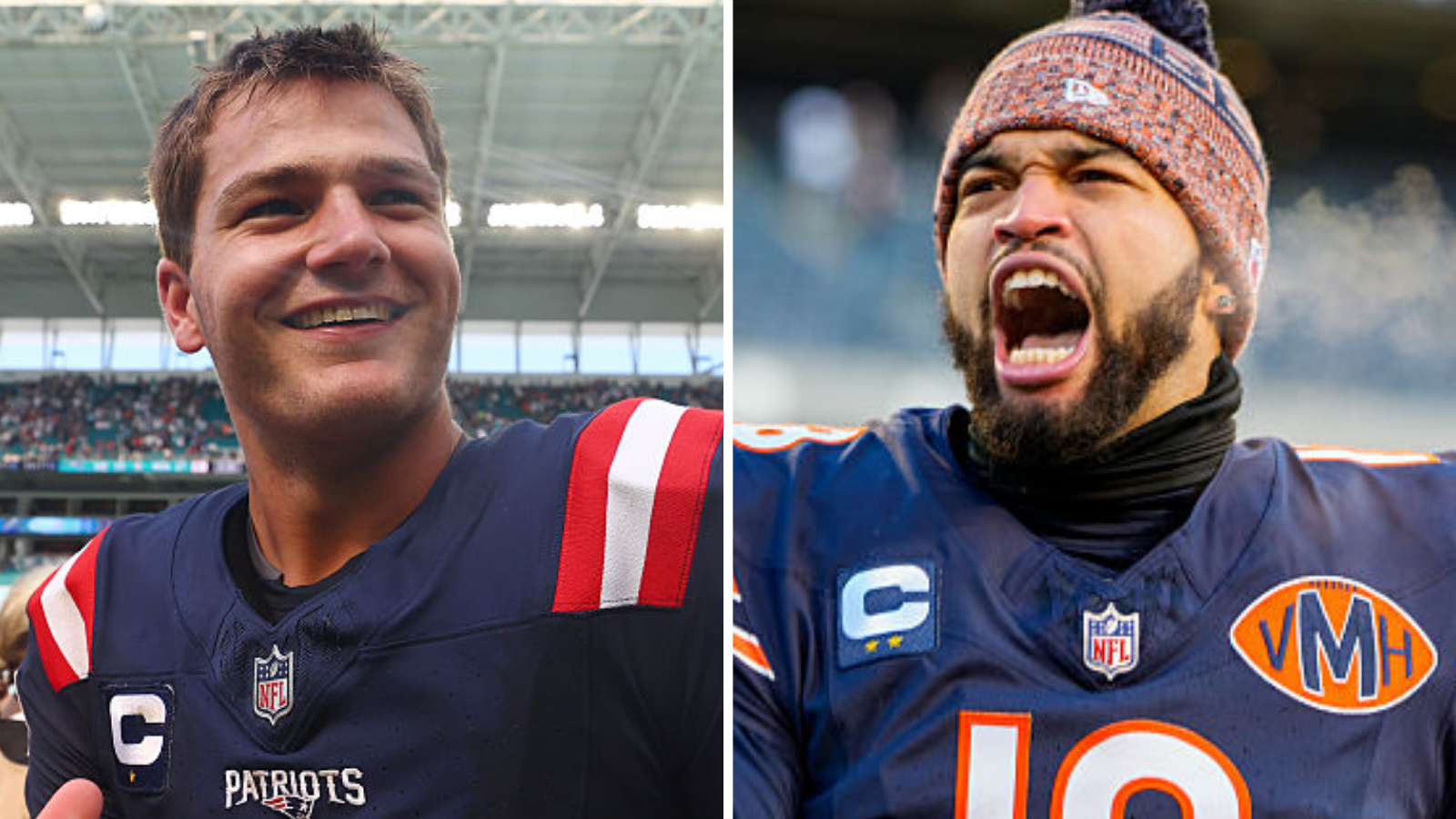
Top-three 2024 draft picks, New England's Drake Maye and Chicago's Caleb Williams
One dominant era has ended, veteran leaders have struggled, and unexpected teams have risen to become championship contenders.
As noted by experienced analyst Cris Collinsworth, "this is the most unusual year I can remember in the NFL."
The playoff field is set with 14 teams, marking the first time in over a decade that the Kansas City Chiefs are not participating.
Philadelphia, the reigning titleholders, have looked more vulnerable, and clubs such as Buffalo, considered favorites before the season, have underwhelmed.
Yet, showcasing the competitive balance, 11 playoff qualifiers won 11 or more games, a rarity seen just one other time in the last three-and-a-half decades.
A record five teams qualified after suffering 11 or more losses the previous year, with two—New England and Chicago—completing a "worst-to-first" turnaround in their divisions.
"If you ask me to pick a favourite, I don't know, because you can put something on all of them," Collinsworth added.
"Witnessing these emerging quarterbacks compete will be incredible, given their unknown ceilings. These moments are where football legends start their journeys."
Understanding the NFL Playoff Structure
Fourteen teams enter the postseason, split evenly with seven representatives from both the AFC and NFC.
Over three weeks and twelve elimination games, the AFC and NFC are kept apart until their champions meet in Super Bowl 60 on February 8.
Superior seeds host their games, and the top-ranked teams, Denver and Seattle, skip the first playoff round, known as Wildcard Weekend.
Denver and Seattle start their playoff runs in the Divisional Round. The AFC and NFC champions, decided in the Conference Championship games, will play for the Lombardi Trophy at Levi's Stadium.
The possibility exists for a Seattle-Denver Super Bowl replay from 2014, despite Denver's subsequent victory in the last Super Bowl held at Levi's Stadium back in 2016.
The AFC Championship Picture: A Field of Opportunity
With Kansas City's Patrick Mahomes absent from the playoffs for the first time in his career, a major postseason fixture is missing.
Adding to the change, Super Bowl 60 will lack both Mahomes and Joe Burrow of Cincinnati, breaking a streak dating back to 2019.
With recent MVPs Mahomes and Lamar Jackson (Baltimore) also out, the AFC playoff field lacks its recent dominant forces, creating a void for new contenders.
The path to the AFC title is therefore unobstructed, allowing rising talents including Bo Nix of Denver and New England's Drake Maye to pursue playoff immortality.
The AFC champion has come from a very small group since 2016, and the players from those winning teams have all since moved on.
Denver, despite its high seed, is a playoff novice in recent years, and the Pittsburgh Steelers are the sole other AFC qualifier to have reached a Super Bowl in the past three decades.
However, two veteran AFC quarterbacks with extensive pedigrees—Aaron Rodgers of Pittsburgh and Buffalo's Josh Allen—could use their experience to challenge the newcomers.
Who Are the Super Bowl and MVP Favorites?
The NFC boasts more recent playoff pedigree, with Philadelphia, Los Angeles, or San Francisco appearing in seven of the last eight Super Bowls.
The Rams and 49ers have felt postseason pressure for a while, competing intensely with Seattle in what is considered the NFL's toughest division, the NFC West.
The Seahawks claimed the division crown with a 14-3 mark, riding a seven-game victory streak into the postseason after besting both the Rams and 49ers late.
This earned Seattle the NFC's top seed, making them slight Super Bowl favorites, just ahead of the 12-5 Rams, whose quarterback Matthew Stafford is the MVP frontrunner.
Despite his Super Bowl ring from 2022, Stafford has yet to be named MVP and is positioned just ahead of New England's Drake Maye in the award race.
The development of Maye, aided by head coach Mike Vrabel, has been central to the Patriots' remarkable turnaround from four wins to fourteen.
Similarly, Chicago's Caleb Williams has blossomed in his second year with new coach Ben Johnson, leading the Bears from five wins to eleven and securing the NFC's number two seed.
Schedule for Wildcard Weekend
All times are in GMT
Saturday, 10 January
Los Angeles Rams @ Carolina Panthers (21:30)
Chicago Bears welcome the Green Bay Packers (01:00 Sunday)
Sunday, 11 January
The Bills are on the road against the Jacksonville Jaguars (18:00)
San Francisco 49ers @ Philadelphia Eagles (21:30)
Los Angeles Chargers @ New England Patriots (01:00 Monday)
Monday, 12 January
Houston Texans @ Pittsburgh Steelers (01:00 Tuesday)
Key Storylines for Wildcard Weekend
The Rams begin Wildcard Weekend in Carolina, a team that made history by reaching the playoffs with a losing 8-9 record after stumbling to the NFC South title.
The Rams, playing as visitors, are powered by Matthew Stafford's league-leading passing numbers and a record year from wideout Puka Nacua.
The Packers, slowed by key injuries, get quarterback Jordan Love back from concussion for a rare playoff meeting in football's longest-standing rivalry.
Despite exceeding expectations by winning the NFC North, Chicago faces pressure to avoid a third consecutive loss and an early playoff exit.
San Francisco, dealing with numerous injuries, must challenge the reigning champion Eagles in Philadelphia, a team that enters well-rested.
Buffalo's Josh Allen, the reigning MVP, hopes to finally reach the Super Bowl, but the Bills must travel to Jacksonville, a team riding an eight-game winning streak.
{New England aims to avoid an upset at home against the Los Angeles Chargers, whose quarterback Justin Herbert seeks his first playoff win in his sixth season.|The Patriots hope to defend their home field against the Chargers, as LA's quarterback Justin Herbert looks for his inaugural postseason victory in year six.|At home, New England tries to stave off the Chargers, with Justin Herbert attempting to secure his first career playoff


